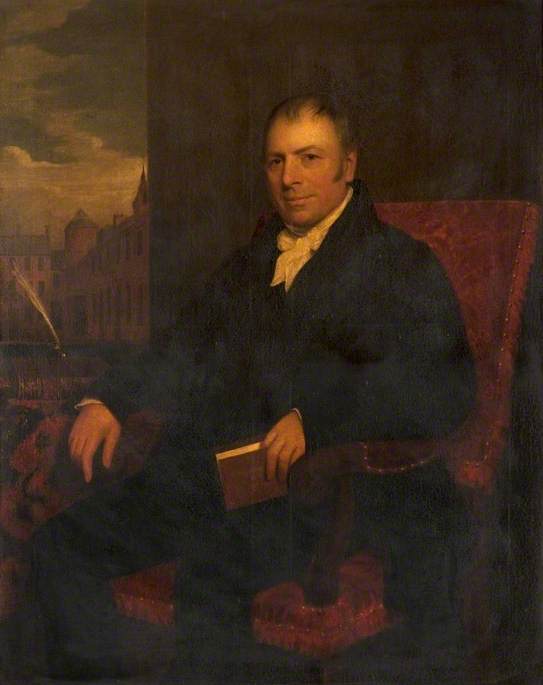
John Alston’s ‘gift’ to Glasgow was to the blind people of the city in that he developed a system of raised letters, known as Alston type which, with appropriate teaching, allowed them to read. This was a precursor of the system developed by Louis Braille which ultimately was preferred.
John Alston’s family can be traced back to the early 18th century in Glasgow. His grandfather, also John, was a tailor in Glasgow and became a burgess and guild brother of the city via his father John in 1725.[1]
His grandfather married Christian (Christina) Calderhead in 1756[2] and they had two boys, John, born in 1757[3], and Thomas, born in 1758[4], the father of the subject of this post. The brothers became burgesses and guild brothers in due course, John in 1803[5] and Thomas in 1786[6], both being described as weavers.
Thomas married Isabella Helen Miller circa 1779. They had a number of children, the first born being John in 1778.[7] She died around 1790, Thomas marrying Annabella Graham in 1792.[8]
John also became a weaver and in 1803 in the Glasgow Post Office directory their company is listed as Thomas Alston and Son, manufacturers, located at 55 St. Andrew’s Square.[9] The year before he had become a burgess and guild brother of Glasgow.[10] Like his father John joined the incorporation of weavers of the Trades House, Thomas having been Deacon Convener of the weavers in 1794/95, 1802/03 and again in 1807/08.[11]
The business continued to operate with the involvement of Thomas and John until 1814 when Thomas died of consumption.[12] From 1815 until 1823 it retained the original company name, located in St. Andrew’s Square, thereafter at various times in Glassford Street and Garthland Street. In 1815 the directory has John living in Stirling Street.[13]
He continued to play his part in the Trades house, in 1810/11 becoming the Deacon Convener of the weavers[14] and in 1819 was the collector of the Trades House.[15] In 1825 he became a Glasgow councillor put forward by the Trades House[16], in 1827 becoming a Bailie holding that position for three years.[17] He was elected Deacon Convener of the Trades House in 1829/30.[18] In 1821 and at other times he was also a member of the Dean of Guild Court. [19]
After 1823 John continued to operate the company in his own name until 1828 when he was joined, I believe, by his son Thomas, the company name being John Alston and Son located at 55 Glassford Street.[20] In 1828 Thomas also became a burgess and guild brother of Glasgow.[21]
He continued to live in Stirling Road (name change from street) until 1830 when he moved to Rosemount, Garngadhill[22] where he lived for the rest of his life.
He had married Margaret Scott in 1802, daughter of William Scott, a fellow manufacturer.[23] They had ten children, three girls and seven boys, three of whom, one girl and two boys did not survive beyond one year.[24] Son Thomas was born in 1805.[25]
John can truthfully be described as one of Glasgow’s true philanthropists as his charitable activity primarily was aimed at a section of the population who were blind and needed financial support, education and other assistance to live their lives. He also provided financial help to the Old Men’s Society which allowed the creation of a building to house them, more of which later.
On the 5th of January 1827 there appeared a notice in the Glasgow Herald announcing a meeting to be held on the 15th of the month to discuss the building of an asylum for the blind of Glasgow. This was brought about by the Deed of Settlement of John Leitch who bequeathed £5000 for that purpose.[26] In the event that sum was insufficient and further funds were gained through the efforts of John Alston and James Ewing, who became Lord Provost of the city in 1832 and one of the city’s first MPs in the same year.[27] The asylum duly opened in 1828.[28]
Alston continued to support the asylum in many different ways but most importantly in developing a type of raised letters that would allow the blind to read. In 1836 he modified a system developed by Dr Fry of London, changing the letters of Fry’s system to the Roman alphabet and making each letter thinner and sharper. He was in due course able to develop a press which produced this modified version of Fry’s type, thus enabling the printing of parts of the bible and other material. By 1839, according to Alston, ‘Alston Type’ was in use in the majority of blind institutions in England and Scotland.[29]
A more detailed and comprehensive study of Alston’s work in this respect has been written by Carol Parry, Trades House Honorary Librarian, entitled ‘John Alston: Helping the Blind to Read.’
https://www.tradeshouselibrary.org/apps/search?q=Carol+Parry
In July 1844 John received letters from King Frederick William and Queen Elsabeth of Prussia praising his work in Glasgow and his books printed in Alston Type. The article from the Glasgow Herald is shown below.[30]


He performed various duties with the Blind asylum, the last of which was as treasurer in 1846.[31]
The ‘Old Man’s Friend Society’ was formed in 1811. Initially the care or relief provided was in the recipient’s own home. That lasted until 1836 when a building was procured in Rottenrow. By early 1845 there were 61 inhabitants.[32]
By August of 1845 a new building had been erected in Rottenrow, this time described as an asylum for ‘Indigent Old Men’, the funds for it being raised by Alston and fellow merchant William Morgan.[33]
He was involved in a wide range of charitable organisations some of which are detailed below.
- Glasgow Royal Infirmary, director and visitor.[34]
- Glasgow Eye Infirmary, director.[35]
- Donated 10 guineas to the Relief of the Indigenous Poor and persuaded 21 ladies to run a bazaar (21 stalls) for funds for the charity. The entry price which was one shilling and the sales from the stalls raised £1558 16s 6d, with 6306 people attending over two days.[36] Today that sum in RPI terms would equate to over £163,000, by other measures it could be as valuable as £6m.[37]
- Treasurer of Relief Fund Committee.[38]
- Glasgow Deaf and Dumb Institution, director.[39]
- President of the Glasgow Humane Society.[40]
- Gorbals Benevolent Society, honorary director.[41]
John Alston died on the 20th August 1846, cause of death recorded as a stomach complaint.[42] The business continued until 1862-63, the last time there was an entry in the directory for John Alston and Son.[43] Who ran the business until then is not known as son Thomas died on the 13th of April 1847.[44] Possibly one of the other brothers although they had been far travelled, three to Australia, two dying there, and one to the Caribbean, who died in Glasgow in 1869.
[1] Anderson, James R. (ed). (1925) The Burgesses and Guild Brethren of Glasgow 1573-1750. Edinburgh: Scottish Record Society. p.379. https://archive.org/details/scottishrecordso43scotuoft/page/378/mode/2up
[2] Marriages (OPR). Scotland. Glasgow. 18 April 1756. ALSTON, John and CALDERHEAD, Christian. 644/1 250/169. www.scotlandspeople.gov.uk
[3] Births (OPR). Scotland. Glasgow. 3 February 1857. ALSTON, John. 644/1 121/241. www.scotlandspeople.gov.uk
[4] Births (OPR). Scotland. Glasgow. 5 April 1858. ALSTON, Thomas. 644/1 130/96. www.scotlandspeople.gov.uk
[5] Anderson, James R. (ed). (1935) The Burgesses and Guild Brethren of Glasgow 1751-1846. Edinburgh: Scottish Record Society. p.231. https://archive.org/details/scottishrecord51scotuoft/page/230/mode/2up
[6] Anderson, James R. (ed). (1935) The Burgesses and Guild Brethren of Glasgow 1751-1846. Edinburgh: Scottish Record Society. p.154. https://archive.org/details/scottishrecord51scotuoft/page/154/mode/2up
[7] Births (OPR). Scotland. Glasgow. 8 May 1778. ALSTON, John. 644/1 160/395. www.scotlandspeople.gov.uk
[8] Marriages (OPR). Scotland. Glasgow. 1 July 1792. ALSTON, Thomas and GRAHAM, Isobel. 644/1 270/124. www.scotlandspeople.gov.uk
[9] Directories. Scotland. (1803) Glasgow Directory. Glasgow: W. McFeat and Co. p. 7. https://digital.nls.uk/directories/browse/archive/87872945
[10] Anderson, James R. (ed). (1935) The Burgesses and Guild Brethren of Glasgow. Edinburgh: Scottish Record Society. p.218. https://archive.org/details/scottishrecord51scotuoft/page/218/mode/2up
[11] The Trades House Digital Library. Incorporation of Weavers of Glasgow Past Deacons. https://www.tradeshouselibrary.org/past-deacons10.html
[12] Deaths (OPR). Scotland. Glasgow. 24 June 1814. ALSTON, Thomas. 644/1 520/257. www.scotlandspeople.gov.uk
[13] Directories. Scotland. (1815). Glasgow Directory. Glasgow: A. McFeat. p.15.
https://digital.nls.uk/directories/browse/archive/83285249
[14] The Trades House Digital Library. Incorporation of Weavers of Glasgow Past Deacons. https://www.tradeshouselibrary.org/past-deacons10.html
[15] Directories. Scotland. (1819). Glasgow Directory. Glasgow: W. McFeat. p.14. https://digital.nls.uk/directories/browse/archive/83429980
[16] Directories. Scotland. (1826). Glasgow Directory. Glasgow: W. McFeat. Appendix p.1. https://digital.nls.uk/directories/browse/archive/83274711
[17] Directories. Scotland. (1827). Glasgow Directory. Glasgow: W. McFeat. Appendix p.1. https://digital.nls.uk/directories/browse/archive/83296928
[18] The Trades House Digital Library. Trades House Deacon Conveners from 1604. https://www.tradeshouselibrary.org/deacon-convenors.html
[19] Directories. Scotland. (1821). Glasgow Directory. Glasgow: W. McFeat. p.5. https://digital.nls.uk/directories/browse/archive/83436482
[20] Directories. Scotland. (1828). Glasgow Directory. Glasgow: W. McFeat. p.17. https://digital.nls.uk/directories/browse/archive/83439631
[21] Anderson, James R. (ed). (1935) The Burgesses and Guild Brethren of Glasgow 1751-1846. Edinburgh: Scottish Record Society. p.367. https://archive.org/details/scottishrecord51scotuoft/page/367/mode/2up
[22] Directories. Scotland. (1830/31). Glasgow Directory. Glasgow: Letter Carriers of the Post Office. p.29. https://digital.nls.uk/directories/browse/archive/87852879
[23] Marriages (OPR). Scotland. 19 April 1802. ALSTON, John and SCOTT, Margaret. 644/1 270/323. www.scotlandspeople.gov.uk
[24] Births (OPR). Scotland. Glasgow. 1803 – 1819. ALSTON. www.scotlandspeople.gov.uk
[25] Births (OPR). Scotland. Glasgow. 5 December 1805. ALSTON, Thomas. 644/1 200/197. www.scotlandspeople.gov.uk
[26] Glasgow Herald. (1827) Glasgow Asylum for the Blind. Glasgow Herald 5 January. https://www.nls.uk/
[27] The Glasgow Story. James Ewing. https://www.theglasgowstory.com/image/?inum=TGSA05220
[28] Glasgow Herald. (1828) Glasgow Asylum for the Blind. Glasgow Herald 5 January. https://www.nls.uk/
[29] Glasgow Trades House. https://www.tradeshouselibrary.org/
[30] Glasgow Herald (1844) Glasgow Asylum for the Blind. Glasgow Herald. 5 August. https://www.nls.uk/
[31] Glasgow Herald. (1846) Glasgow Asylum for the Blind. Glasgow Herald.26 January. https://www.nls.uk/
[32] Glasgow Herald. (1845) Old Man’s Friend Society. Glasgow Herald 24 March. https://www.nls.uk/
[33] Glasgow Herald. (1845) Indigent Old Men Asylum. Glasgow Herald 18 August. https://www.nls.uk/
[34] Glasgow Herald. (1826) The Thirty First Meeting of the Glasgow Royal Infirmary. Glasgow Herald 9 January. https://www.nls.uk/
[35] Ibid.
[36] Glasgow Herald. (1826) Ladies Bazaar – Assembly Rooms. Glasgow Herald 22 December. https://www.nls.uk/
[37] Measuring Worth (2023) https://www.measuringworth.com/calculators/ukcompare/
[38] Glasgow Herald. (1844) The Late Robert Dalglish Esq. Glasgow Herald 12 January. https://www.nls.uk/
[39] Glasgow Herald. (1844) Glasgow Deaf and Dumb Institution. Glasgow Herald 10 May. https://www.nls.uk/
[40] Glasgow Herald. (1845) Glasgow Humane Society. Glasgow Herald 18 August. https://www.nls.uk/
[41] Glasgow Herald. (1845) Glasgow October 17. Glasgow Herald 17 October. https://www.nls.uk/
[42] Deaths (OPR). Scotland. Glasgow 20 August 1846. ALSTON, John. 644/1 570/ 6. www.scotlandspeople.gov.uk
[43] Directories. Scotland. (1862/63). Glasgow Directory. Glasgow: Letter Carriers of the Post Office. p.52. https://digital.nls.uk/directories/browse/archive/86324346
[44] Deaths (OPR) Scotland. Glasgow. 13 April 1847. ALSTON, Thomas Scott. 644/1 570/64.

 Glasgow's Benefactors